
Home base on the Huron River since day one
Epoxy Flooring in Ann Arbor, MI
We coat garage, basement and shop slabs across every Ann Arbor neighborhood, from river-valley lots to the west side hills.
- Free on-site estimate with a slab moisture test
- Itemized written quote before any work begins
- Full diamond grind and crack repair under every coating
Ann Arbor Floors, House by House
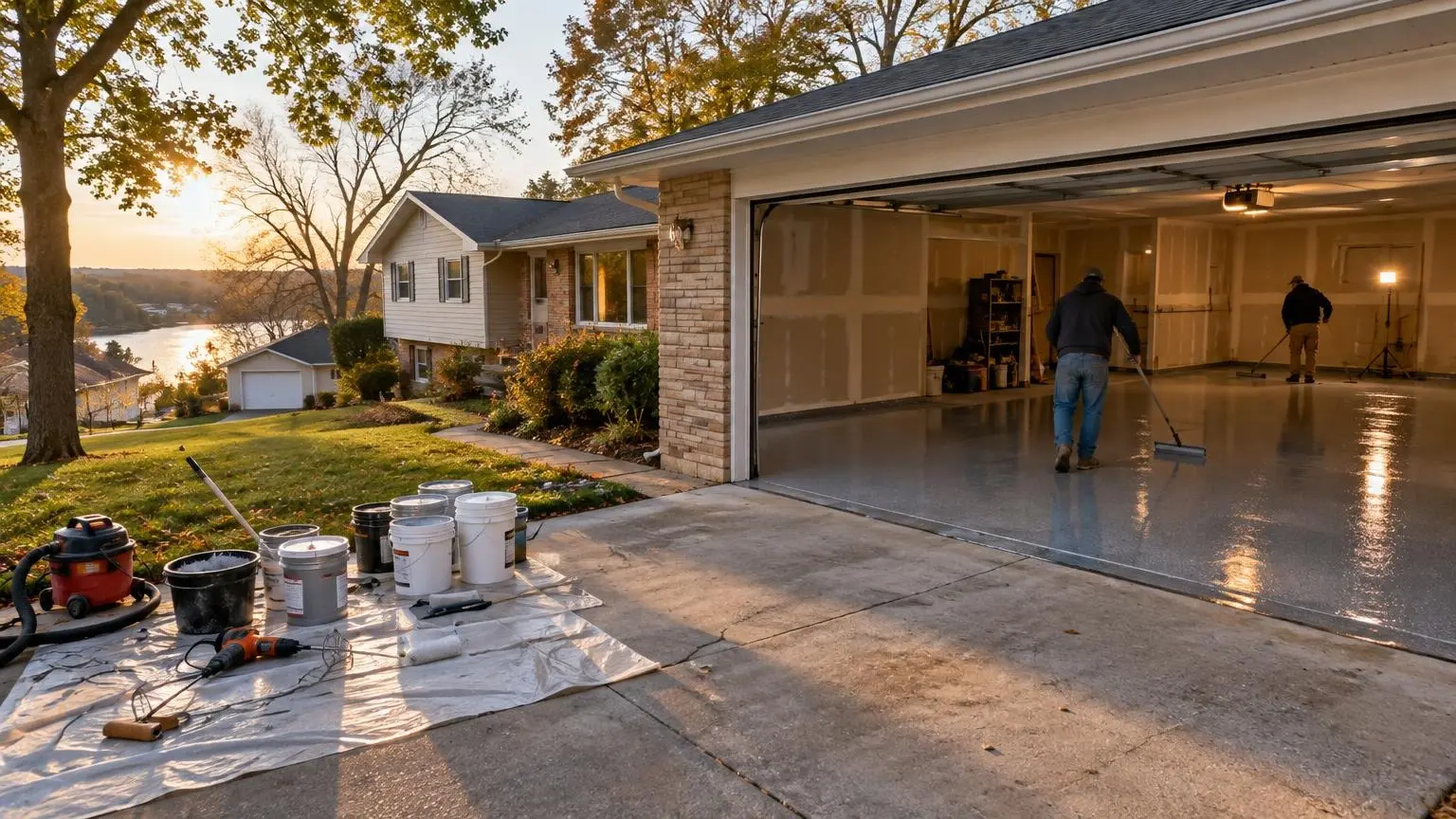
Epoxy flooring in Ann Arbor is our everyday work, and no two slabs in this city start in the same shape. The town was platted in 1824 on 640 acres bought for $800. It has been adding houses ever since, and each era left a different kind of concrete behind. Before we talk about color or flake size, we look at when your house was built, where it sits on the land and how the floor has been used.
Three eras of slab we see most
Half the homes in the city were built before 1971, by Census survey data for 2019 to 2023. Here is how that plays out on the floor:
- Before 1940 (about 15% of homes): detached garages behind older houses, often with thin, patched slabs and decades of oil. Basements tend to be low, with rough floors that were never meant to be finished.
- 1960s and 1970s (about a third of homes): ranches and split-levels with attached two-car garages. The concrete is usually sound but tired, and many floors carry an old coat of paint or sealer that has to come off completely.
- After 2000 (about 16% of homes): newer houses and townhomes with smooth, hard-troweled slabs. They look clean, but a coating will not grip that slick surface until it has been ground.
Hills, river valley and what sits under the slab
Ann Arbor is not flat. Wikipedia puts the low point at about 750 feet along the Huron River and the high point at about 1,015 feet on the west side near Maple Road. The ground gets steeper close to the river. A house on a slope often has a walkout basement, with part of the slab below grade and part at ground level. The buried side tends to stay cooler and damper. We take moisture readings at more than one spot on these floors, because one test in a dry corner can miss a wet wall on the uphill side.
Cold that reaches the garage floor
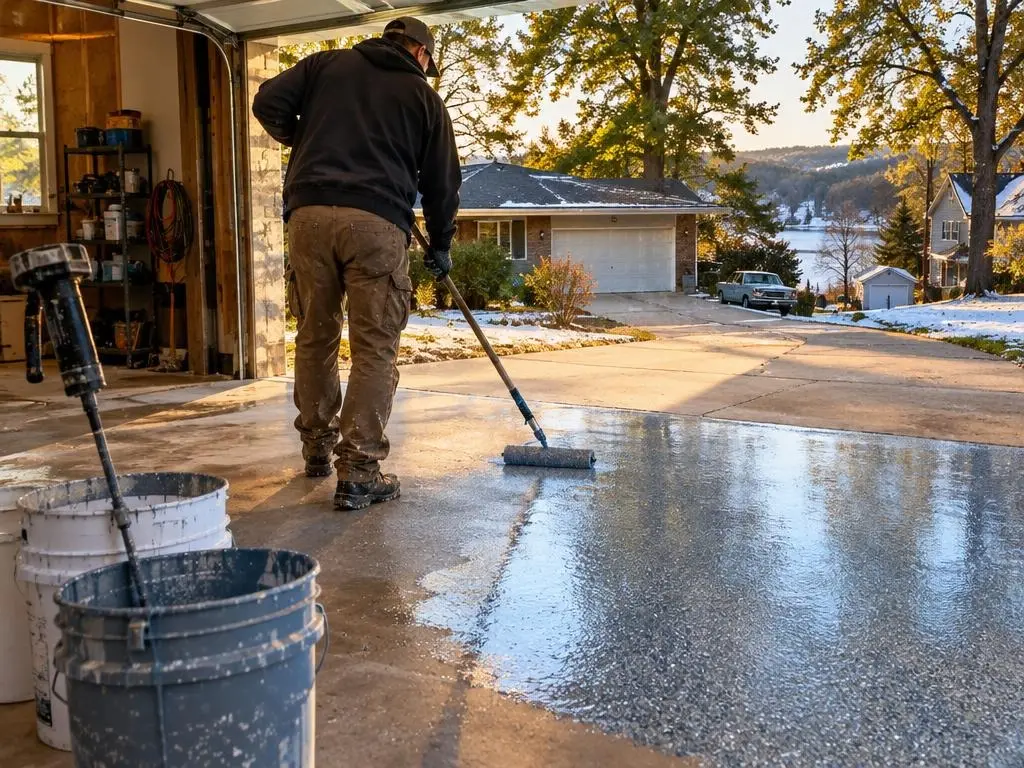
The city averages highs near 34°F in winter, and on about four or five nights a year it drops to 0°F or below. Snow usually falls from November into April. An attached garage stays a bit warmer than outside, but the slab near the door still freezes and thaws through the season. Meltwater from the car pools there, and salt brine sits in the low spots. That front strip is where we see the most scaling and where crack repair matters most before a coat goes down.
Rentals and owner homes need different floors
Census figures show about 45.5% of Ann Arbor homes are owner-occupied. More than half are rented, many of them near the University of Michigan campus. We plan the floor around who will use it:
- Landlords usually want a basement or garage floor that is quick to clean between tenants. A solid-color epoxy or a fine flake with a tough topcoat makes sense here.
- Owners finishing a basement for a family room, gym or studio more often pick a metallic finish or a decorative flake blend.
- Fast turnarounds between leases are where polyaspartic coatings help. They cure much faster, so the space is back in use sooner.
Radon and the basement floor
County health officials estimate that over 40% of local homes exceed the radon level at which the EPA advises action. Radon comes from soil and rock. It enters through cracks, sump pits and other openings in the foundation. A test kit is cheap and simple. Do the test before the basement floor is coated, and again after any mitigation work. Filling cracks and coating a slab does not fix a radon problem. If a mitigation pipe and fan go in, we coat around the suction point and leave the sump lid easy to remove.
Older neighborhoods
The Old West Side was listed on the National Register of Historic Places in 1972, and its 19th-century streetscape is still mostly intact. Many lots there and near downtown have small detached garages and tight driveways. That affects how we stage the job, where our equipment sits and how we keep grinding dust out of the house. Floor coating is interior work. If your project also touches the outside of a building in a protected district, check with the city first.
Floors we coat in Ann Arbor
- Attached and detached garages, including one-car garages on older lots
- Basements in ranches, split-levels and walkouts
- Laundry rooms, mudrooms and utility rooms
- Home gyms and workshops
- Small business floors, storage rooms and service areas
Choosing between epoxy and polyaspartic in town
Both work well on Ann Arbor floors. The choice usually comes down to timing and use. Epoxy builds thick in one coat and suits basements and shops where the room can sit for a few days. Polyaspartic cures fast and holds its color in sunlight, which helps on a garage that faces the street with the door open all summer. Many of our garage jobs use both, with epoxy underneath for thickness and polyaspartic on top for speed and color hold.
Booking around the school year
In a college town, timing matters. Rentals turn over in late spring and late summer, and many landlords want floors done in the gap between leases. Owners often book garage work for fall, before the first snow, so the floor is sealed before salt season starts. Tell us your deadline at the estimate and we will plan the schedule around it.
What to Know About Ann Arbor Homes
- Median home built in 1971. Census survey estimates for 2019 to 2023 put 18.5% of homes in the 1960s and 15.2% in the 1970s. About 14.8% were built before 1940.
- About 61 inches of snow. The 1991 to 2020 climate table on Wikipedia lists 61.4 inches of snow a season. The record low is -23°F, set in February 1885.
- More renters than owners. Census QuickFacts lists a 45.5% owner-occupied rate and a $453,400 median owner home value for 2020 to 2024.
- County radon levels. The county health department estimates over 40% of Washtenaw homes exceed 4.0 pCi/L, the EPA action level, and urges every household to test.
Ann Arbor Questions
My 1970s Ann Arbor garage has old gray paint on the floor. Can you coat over it?
We do not coat over old paint. It gets ground off along with any sealer, so the new coating bonds to bare concrete. Paint that is already peeling would take a new floor with it. Removing it is part of the prep we price in writing.
Does a walkout basement need a different system?
Sometimes. The buried side of a walkout slab often reads damper than the side at grade. We test both. If the readings are high, we use a primer made for damp concrete before the main coat goes on.
I rent out a house near campus. What floor holds up best between tenants?
Most landlords pick a solid color or fine flake under a durable topcoat. It hides scuffs and wipes clean. If the unit is empty for only a few days, a polyaspartic system lets it go back into use sooner.
Free Estimates in Ann Arbor, MI
Written quotes for Ann Arbor garages, basements and shops.
Epoxy Flooring Near Ann Arbor
- Epoxy Flooring in Ypsilanti, MI
- Epoxy Flooring in Ypsilanti Township, MI
- Epoxy Flooring in Pittsfield Township, MI
- Epoxy Flooring in Scio Township, MI
- Epoxy Flooring in Ann Arbor Township, MI
- Epoxy Flooring in Superior Township, MI
- Epoxy Flooring in Saline, MI
- Epoxy Flooring in Dexter, MI
- Epoxy Flooring in Chelsea, MI
- Epoxy Flooring in Manchester, MI
- Epoxy Flooring in Milan, MI
- Epoxy Flooring in Whitmore Lake, MI
- Epoxy Flooring in Brighton, MI
- Epoxy Flooring in Howell, MI
- Epoxy Flooring in Pinckney, MI
- Epoxy Flooring in Hamburg Township, MI
- Epoxy Flooring in Genoa Township, MI
- Epoxy Flooring in Green Oak Township, MI
- Epoxy Flooring in Hartland Township, MI
- Epoxy Flooring in Monroe, MI
- Epoxy Flooring in Dundee, MI